
Direction régionale de santé publique de Montréal
Direction régionale de santé publique de Montréal
Conseils et prévention
Pour savoir quoi faire ou qui consulter pour améliorer ou protéger ma santé, celle de ma famille ou de mes proches.
Childhood vaccinations : Don’t miss it
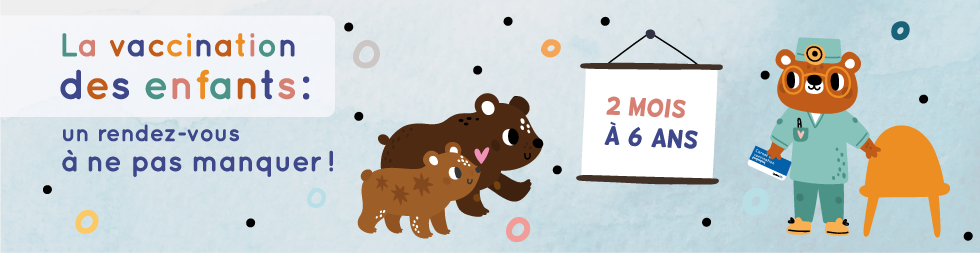
Schedule an appointment for your child’s vaccination (at 2 months, 4 months, 12 months, 18 months and between 4 and 6 years of age)
Before going to your child’s appointment
Please bring your child’s vaccination card with you to all medical appointments. The healthcare professional will be able to check whether your child’s vaccinations are up to date.
Keep your child’s vaccination card in a safe place so you can find it easily.
It’s important to have a copy of the pages in the vaccination card, so please take a photo of them or scan them. The copy will come in handy if you lose the original.
Lost vaccination card
If you lose your child’s vaccination card, you can:
- Use your complete copy of the vaccination card, if you have one.
- Otherwise, submit a request to obtain a copy of your child’s information from the Québec vaccination registry (form to complete and mail in).
Even without a vaccination card, you can still make an appointment at the recommended ages. You will be given a paper proof of vaccination on site.
Make an appointment
Appointments for the vaccination of children ages 0 to 5 can be made at CLSC in each of Montréal’s CIUSSS. You can schedule an appointment through the Clic Santé online platform :
For the phone numbers and addresses of each CLSC : Find your CIUSSS using your postal code.
Tutorial on making an appointment online (only available in French)
Check to see whether your child is up to date on their vaccinations
Vaccines your child should receive based on their age
Vaccines are most effective when given at the right time! Schedule appointments at the key moments listed in the vaccination schedule to give your child the best possible protection.
If your child is older than the recommended age, you should still make an appointment to catch up on any missed doses of vaccine. The healthcare professional can advise you during your appointment.
Here is a list of recommended childhood vaccines by age :
| VACCINE | 2 months | 4 months | 12 months | 18 months | Between 4 and 6 |
|---|---|---|---|---|---|
| Diphtheria-pertussis-tetanus-hepatitis B-polio-Hib |
X |
X | X (without hepatitis B) |
||
| Pneumococcus | X | X | X | ||
| Rotavirus | X | X | |||
|
Meningococcus |
X | ||||
| Measles, rubella, mumps and chickenpox | X | X | |||
| Diphtheria, Pertussis, Tetanus and Polio | X | ||||
| Hepatitis A and Hepatitis B | X |
Source : MSSS (2021). Protocole d'immunisation du Québec (PIQ).
Other recommended vaccines (or preventive measures) based on your child’s age or health condition
Protection against respiratory syncytial virus (RSV) infection
-
An antibody injection (which provides protection against the virus) is recommended for young infants and, under certain conditions, as a preventive measure.
Further information:
Immunization for babies against respiratory syncytial virus (RSV) infections
COVID-19 vaccination
-
The COVID-19 vaccination is recommended under certain conditions.
Further information:
Flu vaccination
-
The flu vaccination is recommended under certain circumstances.
Children under 6 months of age cannot be vaccinated, but they are at risk of complications from the flu. It is recommended that children and anyone living in the same household as a child under 6 months of age also get vaccinated to prevent passing the flu on to the baby.
Further information:
How to check your child’s vaccination card
If you lose your child’s vaccination card, you can request a copy.
Even without a vaccination card, you can still make an appointment at the recommended ages. You will be given a paper proof of vaccination on site.
There are five key moments to keep in mind for childhood vaccinations: 2 months, 4 months, 12 months, 18 months and when starting preschool (between ages 4 and 6). However, it’s never too late to get vaccinated, even if the recommended timeframe has passed.
Steps to follow
- Your child’s vaccination card contains a table listing all the recommended vaccines by age group (see example above). The booklet is then divided into sections for each disease for which a vaccine is recommended.
- Compare the vaccines listed in the different sections of the immunization record with the number of doses indicated in the vaccination schedule. If necessary, you can get help from a healthcare professional, by calling 811, for example.
- If you notice that your child is not up to date on the recommended vaccinations for their age, make an appointment at a CLSC near you
Vaccines received outside of Québec
Did your child receive a vaccine outside of Québec?
- See the CHU Sainte-Justine webpage dedicated to interpreting foreign vaccination records (only available in French).
If necessary, ask a healthcare professional to help you compare your child’s vaccination record with Québec’s.
Tips and tricks for making an appointment
- Please bring your child’s vaccination card with you to all medical appointments. The healthcare professional can check with you to see whether your child’s vaccinations are up to date.
- After your vaccination appointment, make your next appointment right away before leaving the CLSC. Be sure to add it to your personal calendar.
- If you can’t schedule an appointment right away, set a reminder in your calendar one month before the recommended time so you don’t forget to make the appointment.
- If you are hesitating to have your child vaccinated, you can still make an appointment to talk with the nurse, who will be able to answer your questions.
General information on vaccination
Why should you have your child vaccinated?
Having your children vaccinated at the recommended ages is one of the best ways to help them stay healthy and protect them from serious illnesses.
A vaccine reduces the risk of contracting one or more diseases and spreading them to others. If a vaccinated person does contract the disease, the vaccine reduces symptoms and the risk of serious complications.
Diseases that can be prevented by vaccination
Since the very first vaccine in history was developed in 1796, vaccination has proven its worth time and again and continues to have an invaluable positive impact on public health. It reduces the spread of various diseases, lowering absenteeism, complications, hospitalizations and deaths. Vaccination is the best thing you can do to protect your children.
While some vaccine-preventable diseases are no longer in circulation in Québec—or only rarely—there is still a risk of resurgence, especially if vaccination coverage among the population is not high enough. Measles is a good example: it is a disease that had disappeared from Québec but has reappeared in recent years. Measles is highly contagious and can be serious, especially for children under 12 months of age, pregnant women and people with weakened immune systems.
Vaccinating children also reduces the risk of complications or hospitalization from more common illnesses, such as chickenpox, pneumococcal disease and whooping cough.
Whooping cough
-
Definition
- Whooping cough, or pertussis, is a highly contagious respiratory infection caused by bacteria.
- The main symptoms are a runny nose, loss of appetite and a severe cough. The cough can cause vomiting, cessation of breathing or a sound that resembles a rooster’s crow. It can last several weeks.
Situation in Québec
- In Québec, between 2020 and 2023, the annual number of pertussis cases ranged from 25 to 400, with an average of 132 cases per year. In 2024, a peak was observed, with 17,723 cases.
Why get vaccinated?
Babies under 1 year of age are at greater risk of complications if they contract whooping cough. Most infected children under 6 months of age are hospitalized. Whooping cough rarely causes death, but when it does, it is most often in infants under 3 months of age.
Babies under 3 months of age are at much lower risk of complications if the mother was vaccinated during her pregnancy.
The vaccine is recommended for all pregnant women, with every pregnancy. This will keep the baby safe during its first few weeks of life. This is the period when the risk of complications is the highest.
To remain protected, the baby will need to receive their first scheduled vaccination at 2 months of age, followed by the subsequent doses. Vaccinating children helps prevent whooping cough in most cases (about 90%) during the first 4 to 6 years of life.
Getting vaccinated during pregnancy prevents 90% of hospitalizations. It also prevents 95% of deaths among babies 3 months and under.
Further information
- Whooping cough: How can you protect yourself? (only available in French)
- Québec.ca
- Naître et grandir
Measles
-
Definition
- Measles is a serious and highly contagious viral respiratory disease. More than 90% of unvaccinated people who have been exposed to a case of measles develop the disease.
- The classic symptoms are a fever and a rash that appears as widespread redness. Other symptoms may also occur, such as a cough, nasal congestion or a runny nose, red eyes, sensitivity to light and watery eyes.
- 20% of unvaccinated people who contract measles require hospitalization, and many of them will experience serious complications, including neurological aftereffects that can be fatal.
Why get vaccinated?
- Vaccination is the best protection against measles. The vaccine is more than 95% effective after two doses.
- It is estimated that the measles vaccine prevented more than 20.4 million deaths worldwide between 2000 and 2016.
Situation in Québec
Measles was eliminated in Canada in 1998. The few cases were mainly travellers who brought the virus back with them.
Since 2024, there have been several measles outbreaks in Québec and elsewhere in Canada, indicating that the disease has begun to circulate again. The percentage of people vaccinated against measles in Québec is still below the 95% target required to significantly reduce the risk of a measles outbreak. The more people get vaccinated, the wider the vaccination coverage and the lower the risk of an outbreak. Because these outbreaks lasted for a long time, Canada lost its status as a measles-free country in 2025.
Measles is caused by a virus that spreads very easily. A single case of measles can lead to a major outbreak. Vaccination is the best way to protect yourself and prevent the disease from continuing to spread.
Further information
Poliomyelitis (polio)
-
Definition
- Poliomyelitis (polio) is a disease caused by a virus that attacks the nervous system, particularly the nerves that control the muscles.
- Serious complications of the disease include respiratory difficulties, paralysis of the arms and legs—which may be permanent—and death.
Why get vaccinated?
- There is no treatment for polio. Three doses of the vaccine, administered at 2 months, 4 months and 12 months, followed by a booster shot between the ages of 4 and 6, provide lifelong protection and nearly 100% efficacy against the paralysis caused by this disease.
Further information
- Québec.ca – Poliomyelitis
- Naître et grandir – Poliomyelitis (only available in French)
Some facts about vaccination
It is safe to give a child several different vaccines at the same time
-
At any given moment, the human body is in contact with millions of different microbes. Even in a young child, the immune system can easily respond to more than 10,000 microbes at the same time. This means that children can safely receive multiple vaccines on the same day.
Furthermore, vaccines are just as effective when administered at the same time. The reaction after getting vaccinated is the same whether you receive one or more vaccines on the same day.
Preservatives and adjuvants in vaccines are safe
-
The thimerosal contained in certain vaccines is not toxic.
Some people have equated the mercury contained in this preservative with “toxic mercury.” When thimerosal comes into contact with the human body, it breaks down into ethylmercury, a harmless compound that is quickly eliminated by the body.This product should not be confused with methylmercury, which is a toxic contaminant found in certain contaminated fish, for example.
The aluminum salts in certain vaccines are not toxic..Aluminum salts are used to improve the effectiveness of the vaccines. They also enhance the immune response in vaccinated individuals. This is what is called an “adjuvant.” The quantity of aluminum is less than 1 mg per dose of vaccine, which is far less than what is found in many foods we eat every day (vegetables, grains, dairy products, etc.). This metal can be found everywhere: 9% of the Earth’s surface is made up of aluminum. There is no risk in consuming it in very small amounts.
There is no link between the measles, mumps and rubella (MMR) vaccine and autism
-
This belief stems from an unverified and controversial study published in The Lancet in 1998. In fact, the journal retracted the study due to flaws in its methodology (e.g., the study included only 12 children and lacked a control group). No other researcher has ever been able to replicate the study’s results, which is a fundamental principle of science. Finally, the author was even accused of a conflict of interest and scientific fraud.
To address these concerns, new studies have been conducted using medical data from millions of children around the world. These studies have shown that there are no more cases of autism among vaccinated children than among non-vaccinated children. So there is no connection.
Vaccine safety
Development of vaccines
-
Vaccines must undergo many stages of rigorous testing before they are approved in Canada. First, the manufacturer must demonstrate that its vaccine is safe and effective by conducting several rounds of studies involving groups of volunteers. The number of volunteers increases at each stage. These studies compare the immune and physical responses of people who receive the vaccine with those of people who receive saline solution without the vaccine (placebo).
Next, Health Canada thoroughly reviews all the manufacturer’s data to ensure that all safety, quality and efficacy standards are met. If all the standards are met, the vaccine is approved. It can then be distributed in the country, while remaining closely monitored.
Monitoring
-
Every batch of vaccine distributed in Canada is inspected and sampled to ensure that the vaccine is safe. In addition, independent expert committees (from the government and the manufacturer) record and analyze all side effects. This allows the committees to revise the recommendations as needed.
Canada also has a program designed to identify side effects related to childhood vaccinations: the IMPACT program, managed by the Canadian Paediatric Society and deployed in 12 children’s hospitals across the country. One of the goals of this program is to identify unexpected or unusual events leading to a child’s hospitalization following vaccination.
Recognizing credible sources of information
There are many sources of health information, but credible sources are sometimes mixed in with other sources that are not based on recognized scientific principles. Sometimes, these unverified sources even contain misleading information.
A reliable source of information :
- Clearly states its mission and purpose.
- Provides up-to-date information based on reliable scientific data and endorsed by recognized organizations and experts.
- Lists the groups or organizations that fund it, along with their contact information, if applicable.
Further information :
- Québec.ca (How to recognize a reliable source of information on health)
- MSSS video clip (only available in French)
Tools and Resources
Printable resources
-
Tools Format 8.5 × 11-inch checklist 8.5 × 11-inch poster 11 × 17-inch poster 1/3-page bookmark












Questions?
You can get more information about vaccination from a doctor or healthcare professional:
- Call the Info Santé line: 811
- Check with your child’s school nurse
- Contact your local CLSC for more information
- Ask your family doctor
Dernière mise à jour: 2026-04-28